
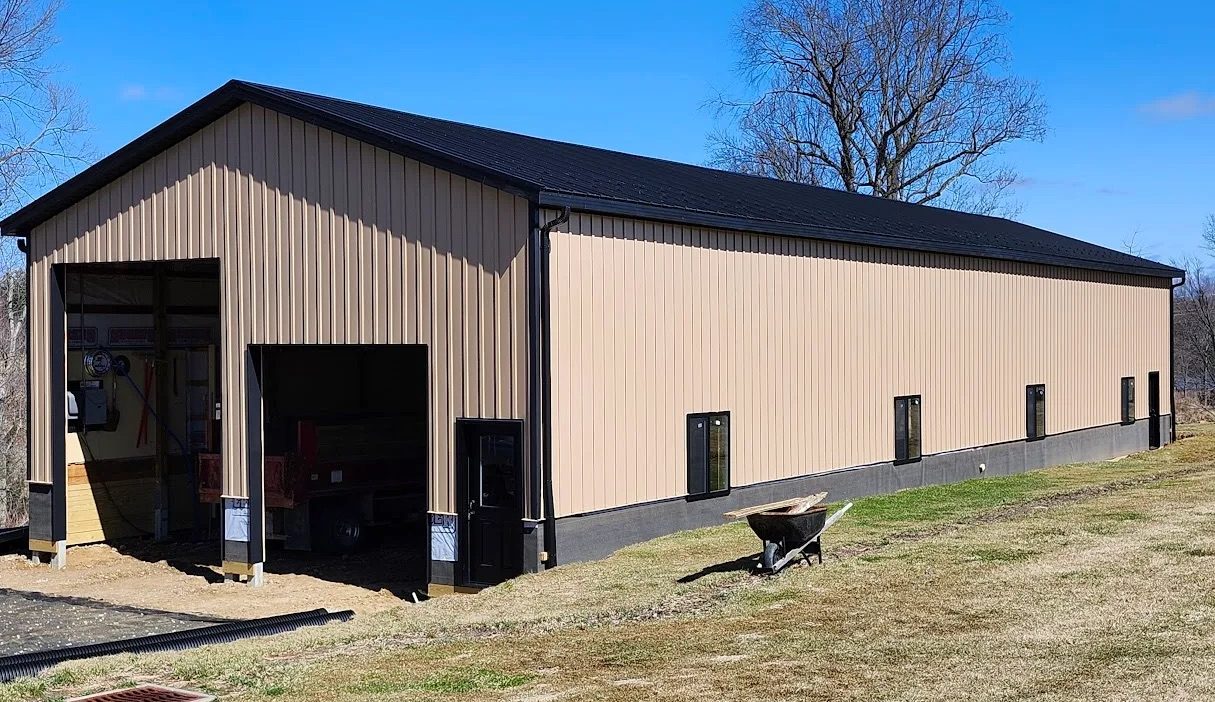
If you own a pole barn in Ohio, you already know how brutal the winters can be. Without proper insulation, that structure becomes little more than a cold, damp shell from November through March. Learning how to insulate a pole barn in Ohio is one of the smartest investments you can make to turn that underused space into a productive, year-round workshop, garage, or hobby area. Whether you are working with a brand-new build or retrofitting an older structure, the right insulation strategy can dramatically change how comfortable and functional your pole barn becomes. For homeowners in Ohio considering a new build alongside their insulation project, professional pole barn services can help ensure the structure is set up for efficient insulation from day one.
Ohio’s climate presents specific challenges that make insulation more complex than in other states. The state sits in a humid continental zone, with cold, snowy winters in the north and hot, humid summers throughout. This combination of temperature swings and persistent moisture means that choosing the wrong insulation method or skipping vapor control can lead to condensation problems, mold, and structural damage over time.
Why Ohio’s Climate Makes Pole Barn Insulation So Critical
Ohio averages between 5,000 and 6,500 heating degree days annually, depending on the region. Northeast Ohio, including the Lake Erie snowbelt, can see even higher numbers. This means a heated pole barn is working hard against cold outdoor temperatures for a significant portion of the year.
Beyond cold, Ohio humidity is a major factor. Warm, moist interior air meeting cold metal or wood surfaces creates condensation, which is the silent enemy of post-frame buildings. Without a proper vapor management strategy, you will likely see rust on metal panels, rot on framing members, and deteriorating insulation within just a few years.
According to the U.S. Department of Energy’s Building Technologies Office, buildings with inadequate vapor control in humid climates can experience significant moisture-related damage that negates any energy savings from insulation alone. This makes the combination of the right insulation type and proper vapor barriers non-negotiable for Ohio pole barns.
The Three Main Insulation Options for Pole Barns
Spray Foam Insulation
Spray polyurethane foam (SPF) is widely considered the premium option for post-frame construction. It comes in two types: open-cell and closed-cell.
Closed-cell spray foam is the stronger performer for pole barns. It achieves R-6 to R-7 per inch, creates an air seal, and acts as its own vapor retarder when applied at sufficient thickness. This is especially valuable in Ohio because it addresses both the thermal and moisture challenges at the same time.
Open-cell spray foam is less expensive but only achieves about R-3.5 to R-4 per inch and is not an effective vapor barrier on its own. It is better suited for interior walls in milder climates or for sound dampening applications.
Pros of spray foam for pole barns: Spray foam conforms to irregular framing and gaps, which is common in post-frame construction. It eliminates air infiltration almost entirely, reducing the draftiness that many pole barn owners complain about in winter. It also adds structural rigidity to wall panels.
Cons of spray foam for pole barns: The cost is the primary barrier. Closed-cell spray foam typically runs between $1.50 and $3.00 per square foot per inch of thickness, meaning a 3-inch application on walls could cost $4.50 to $9.00 per square foot installed. For a large pole barn, this adds up quickly. It also requires professional installation and cannot easily be removed or inspected once applied.
Fiberglass Batt Insulation
Fiberglass batts are the most familiar insulation type and are widely available at hardware stores across Ohio. They are installed between framing members and are rated by R-value, typically R-13 for 3.5-inch batts and R-19 or R-21 for 5.5-inch batts.
For pole barns, fiberglass batts work reasonably well in walls when installed correctly, but they require a separate vapor barrier to be effective in Ohio’s climate. A 6-mil polyethylene sheeting installed on the warm-in-winter side (interior) of the batt is standard practice.
Pros of fiberglass batts: Cost is the biggest advantage. Fiberglass batts are typically available for $0.30 to $0.60 per square foot for materials, making them significantly cheaper than spray foam. They are also a DIY-friendly option for handy barn owners.
Cons of fiberglass batts: Fiberglass batts are prone to sagging over time, especially in ceilings. They do not stop air infiltration on their own, so any gaps around framing members or penetrations reduce their effectiveness significantly. In a pole barn, where framing bays may be irregular and there are numerous penetrations for electrical and plumbing, achieving a tight installation takes extra effort.
For ceilings specifically, blown-in fiberglass or cellulose is often a better choice than batts because it fills gaps more completely.
Rigid Foam Board Insulation
Rigid foam board, including expanded polystyrene (EPS), extruded polystyrene (XPS), and polyisocyanurate (polyiso), offers a middle ground between spray foam and fiberglass in terms of both cost and performance.
EPS foam board runs roughly R-3.8 per inch and is one of the more affordable rigid options at $0.25 to $0.50 per square foot per inch. XPS achieves R-5 per inch and costs $0.40 to $0.65 per square foot per inch. Polyiso can hit R-6 to R-6.5 per inch but may lose some effective R-value in very cold conditions, which is worth noting for Ohio winters.
Rigid foam is particularly effective when installed as a continuous layer on the exterior side of the framing before metal cladding is applied, or on the interior surface as a thermal break. It dramatically reduces thermal bridging through the poles and girts, which is a common weak point in post-frame buildings.
Pros of rigid foam board: Rigid foam does not absorb moisture, making it naturally resistant to mold and rot. It provides good vapor control at sufficient thickness (XPS at 1 inch or more acts as a vapor retarder). It is also easy to cut and install.
Cons of rigid foam board: Rigid board alone may leave gaps at framing connections and edges if not carefully detailed. It also requires a thermal barrier (typically drywall or liner panel) on the interior if code requires fire protection, which adds cost.
Condensation Control and Vapor Barriers: Ohio’s Non-Negotiable Step
Ohio’s humidity levels make vapor management the most critical and most commonly overlooked part of pole barn insulation. The Building Science Corporation has extensively documented how vapor pressure differentials drive moisture into building assemblies, where it condenses on cold surfaces and causes long-term damage.
For heated Ohio pole barns, the vapor barrier or retarder should be placed on the interior (warm in winter) side of the insulation assembly. Common approaches include:
A 6-mil poly sheeting installed over fiberglass batts before interior liner panels go up is the most basic approach. For spray foam, the foam itself handles vapor control when applied at the correct thickness. For rigid foam board, the boards must be taped at seams and carefully detailed around penetrations.
Metal pole barn roofs are especially vulnerable to condensation because metal conducts temperature extremely well. A product called “anti-condensation” or “condensation control” facing, sometimes laminated to steel roofing panels, can help but is not a substitute for insulation with proper vapor control.
If your pole barn already has condensation problems showing as rust streaks or water drips, addressing vapor control during the insulation project is essential before those issues worsen.
R-Value Recommendations for Ohio Pole Barns
The right R-value depends on how you plan to use the space and where in Ohio the barn is located. The Energy Star program and the International Energy Conservation Code (IECC) provide guidance that can be applied to pole barn construction.
Heated workshops and hobby spaces in Ohio: For a conditioned space where you plan to heat the barn regularly, target at least R-25 in walls and R-38 to R-49 in the ceiling or roof. Northeast Ohio, in the IECC Zone 5 and 6 overlap area, warrants the higher end of these ranges. This can be achieved with closed-cell spray foam, a combination of rigid foam plus batts, or blown-in insulation in the ceiling.
Unheated storage barns: For barns used primarily for equipment storage where you are not actively heating the space, a lighter approach is acceptable. Insulating the roof deck with at least R-13 to R-19 helps prevent extreme heat in summer and reduces condensation risk in winter without the full expense of a heated-space assembly. Walls can be left uninsulated or given a minimal R-6 to R-11 with foam board to prevent freezing near sensitive stored items.
Livestock shelters: Animals generate substantial body heat, which changes the insulation equation. The goal shifts toward moisture management and preventing drafts rather than achieving high R-values. R-19 in walls and R-25 in the ceiling is a common target for livestock shelters in Ohio. Vapor management is especially critical here because animals produce significant humidity that must be managed to prevent condensation and respiratory illness.
Cost Comparison at a Glance
To give a realistic picture for a typical 40 x 60 pole barn (roughly 2,400 square feet of wall area plus 2,400 square feet of ceiling):
Fiberglass batts with poly vapor barrier: Materials typically run $1,500 to $3,500 for a DIY approach, with professional installation adding $2,000 to $4,000 more.
Rigid foam board on walls and ceilings: Materials for a 2-inch application run approximately $3,000 to $6,000, with installation adding $2,000 to $4,000.
Closed-cell spray foam: Professional installation typically runs $8,000 to $18,000 for a full barn, depending on target thickness and contractor rates in your area.
Hybrid approaches, such as closed-cell spray foam on the roof deck combined with fiberglass batts in the walls, can balance performance and cost effectively.
Wrapping It All Up: Making Your Pole Barn Work Year-Round
Insulating a pole barn in Ohio is not a one-size-fits-all project. The right combination of insulation type, vapor barrier strategy, and target R-value depends on your intended use, your budget, and your location within the state. What is universally true is that skipping or skimping on this project means losing the barn for roughly five months every year to cold, dampness, and condensation damage.
Spray foam delivers the best performance but at the highest cost. Fiberglass batts are affordable and familiar but require careful vapor barrier installation. Rigid foam board offers an excellent middle ground, especially when used as a continuous thermal break on wall or roof assemblies. For most Ohio pole barn owners heating a workshop or hobby space, a combination approach tends to offer the best balance of performance, moisture control, and budget.
If you are planning a new post-frame structure or need help assessing an existing barn’s insulation needs, consulting with local professionals familiar with Ohio pole barn construction can help you avoid costly mistakes and get the most out of your investment.
Frequently Asked Questions
1. Can I insulate a pole barn myself, or do I need a professional?
Fiberglass batts and rigid foam board are both DIY-friendly for homeowners with basic construction skills. Spray foam, however, requires professional equipment and training and should not be attempted as a DIY project. Regardless of insulation type, it is worth consulting a professional if you have any questions about vapor barriers or if the barn already shows signs of moisture problems.
2. Do I need a vapor barrier in every Ohio pole barn?
Any pole barn that will be heated or that experiences significant interior humidity (from livestock, vehicles, or occupants) should have a vapor barrier or retarder as part of the insulation assembly. Unheated storage barns in dry conditions may get by without one, but adding at least basic vapor control is a low-cost step that protects the structure long-term.
3. What is the minimum R-value for an Ohio pole barn workshop?
For a heated workshop in Ohio, the minimum recommended R-value is R-25 in walls and R-38 in the ceiling. In northeast Ohio or the Lake Erie snowbelt, targeting R-38 in walls and R-49 in the ceiling will provide better comfort and lower heating costs over time.
4. How do I stop condensation on my pole barn’s metal roof?
Condensation on a metal roof is caused by warm, moist interior air reaching the cold metal surface. The most effective solution is to insulate the underside of the roof with closed-cell spray foam or rigid foam board to keep the metal from getting cold enough for condensation to form. Anti-condensation roof panel coatings help in mild cases but are not a substitute for proper insulation.
5. Is spray foam worth the extra cost for a pole barn in Ohio?
For a barn you plan to heat consistently through Ohio winters, closed-cell spray foam is often worth the investment. It handles air sealing, vapor control, and insulation in a single application, and its durability means you are unlikely to need to redo it. For occasional-use or unheated structures, less expensive options like rigid foam board or fiberglass batts may be more cost-effective.