
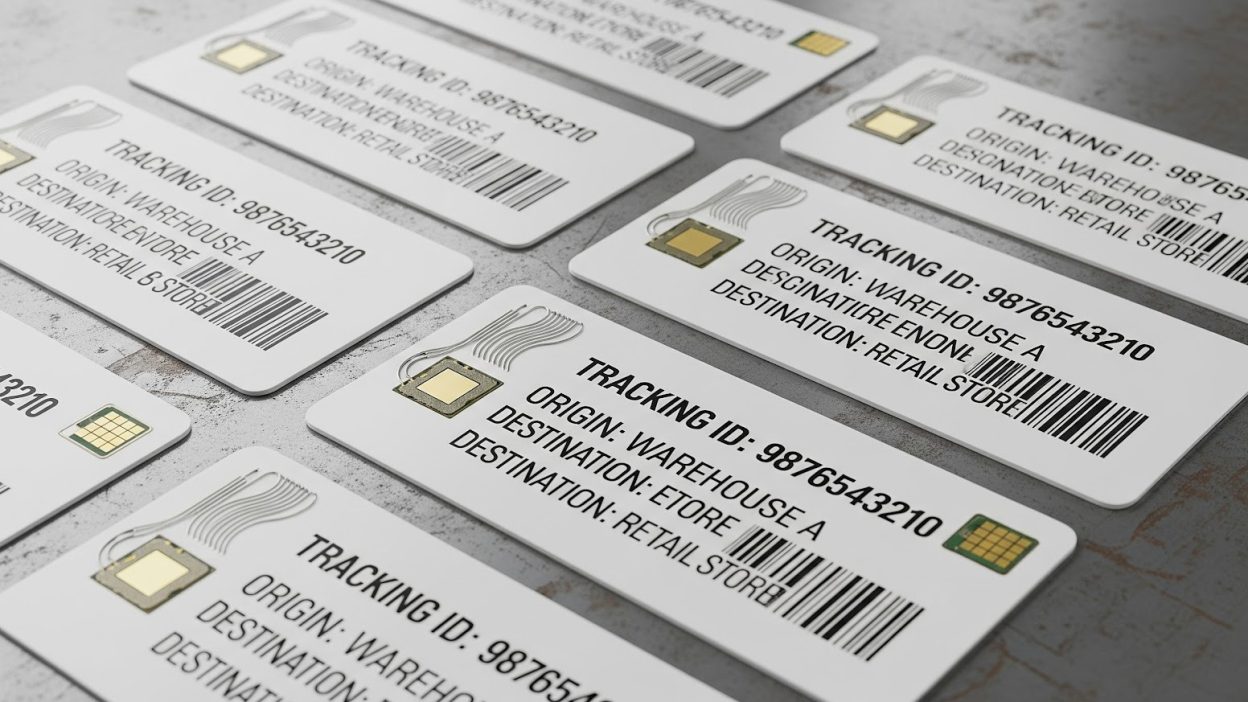
Radio frequency identification technology has reshaped how manufacturers track assets, manage inventory, and optimize supply chains. Yet one of the most common and costly mistakes during an RFID rollout is choosing the wrong tag type. Understanding the difference between active vs passive RFID tags is not just a technical detail. It is the foundation of a deployment that actually works. If your facility is considering RFID shipping tags as part of a broader tracking strategy, getting this decision right from the start will save thousands of dollars and months of frustration.
This guide breaks down how each tag type works, where each performs best, and how to calculate the true cost of ownership before committing to any infrastructure investment.
How Active and Passive RFID Tags Work
At the most fundamental level, active and passive RFID tags differ in one key way: their power source.
Passive RFID tags have no onboard battery. Instead, they harvest energy from the radio waves emitted by a nearby reader. When a reader sends out a signal, the tag’s antenna absorbs that energy, powers the chip briefly, and transmits a response through a process called backscatter. Because passive tags depend entirely on the reader for power, their operational range is limited. Depending on the frequency used, read ranges typically fall between a few centimeters and about 10 meters under optimal conditions. High-frequency (HF) tags used in access control or smart labels generally read within a meter or two, while ultra-high-frequency (UHF) passive tags can stretch to 10 to 12 meters in favorable environments.
Per-unit costs for passive tags are one of their greatest advantages. Basic passive UHF labels can cost as little as $0.10 to $0.50 each when purchased in volume, while more ruggedized versions designed for harsh industrial environments typically range from $1 to $5 per tag. This low per-unit cost makes passive RFID practical for tagging high volumes of pallets, cartons, or individual items.
Active RFID tags carry their own battery and continuously broadcast a signal without waiting for a reader to initiate contact. This self-powered approach dramatically extends read range, typically from 30 meters up to 100 meters or more depending on the system design and environment. Some active systems using Wi-Fi or Zigbee protocols can track assets across an entire yard or warehouse floor in near real time.
The trade-off is cost. Active tags generally range from $15 to $50 per unit on the low end, with specialized or ruggedized models running $100 or higher. Battery life varies, but most active tags last two to five years before requiring replacement or recharging, which introduces an ongoing maintenance cycle that must be factored into any total cost projection.
Where Each Tag Type Performs Best
Choosing between active and passive RFID is not simply about range or price. It is about matching the technology to the specific problem you are trying to solve.
Passive RFID: Inventory Control and Choke Points
Passive RFID excels in scenarios where items move through defined, predictable locations. Think of a receiving dock where pallets pass through a portal reader, a production line where components are scanned as they move between stations, or a shipping area where cartons are verified before loading. In all of these cases, the item comes within range of a fixed reader at a known moment, making limited read range a non-issue.
Pallet-level inventory is one of the strongest use cases for passive UHF tags. A pallet tagged with a passive label will register as it moves through a dock door equipped with RFID antennas, allowing the warehouse management system to update inventory automatically without manual scanning. According to GS1 standards documentation, UHF passive RFID is the preferred technology for item-level and case-level tracking in retail and logistics environments because of this cost-efficiency.
Passive tags are generally not the right choice for assets that move unpredictably across large open areas or anything requiring continuous location updates between fixed reader points.
Active RFID: Real-Time Location and High-Value Assets
Active RFID is the better fit when you need to know where something is at any given moment, not just when it passes a checkpoint. Yard management is a classic example. Tracking trailers, containers, forklifts, or vehicles across a large outdoor area requires the extended range and continuous broadcasting capability that only active tags can provide. A passive system would require dozens of fixed readers to cover the same ground that a handful of active readers can handle.
High-value asset tracking is another natural fit for active RFID. Expensive tooling, returnable containers, powered equipment, and critical spare parts are worth the higher per-tag cost because the cost of losing or misplacing them far exceeds the investment in active tracking. Hospitals use active RFID to track infusion pumps and wheelchairs. Construction companies use it to track heavy equipment across job sites. Manufacturers use it to track dies, fixtures, and calibrated instruments.
Real-time location systems (RTLS) built on active RFID can provide zone-level or even sub-meter accuracy depending on the infrastructure, enabling use cases like worker safety monitoring, automated vehicle guidance, and process compliance verification. The AIM Global RFID Resource Center provides a useful overview of RTLS architectures and the role active tags play within them.
Evaluating Total Cost of Ownership
The sticker price of individual tags is almost never the most significant cost in an RFID deployment. Understanding total cost of ownership (TCO) requires looking at the full system, including readers, infrastructure, software integration, and ongoing maintenance.
Reader and Infrastructure Costs
A passive UHF RFID fixed reader typically costs between $500 and $3,000 depending on the number of antenna ports and the vendor. Each antenna adds another $50 to $300. A dock door portal installation might require one reader and two to four antennas, putting infrastructure cost per choke point at roughly $700 to $5,000 before installation labor and cabling.
Active RFID infrastructure varies widely depending on the protocol. Wi-Fi-based active systems can leverage existing wireless access points, reducing infrastructure investment significantly. Proprietary active RFID systems using dedicated readers may require more extensive installation. In either case, the per-reader cost is typically higher than passive fixed readers, but the coverage area per reader is much larger, which can balance out in large open environments.
Handheld RFID readers for passive systems cost between $1,000 and $3,500, which makes them a practical choice for cycle counting, receiving verification, or other tasks that do not justify a fixed reader installation.
Tag Replacement Cycles
Passive tags with no battery can theoretically last the lifetime of the asset they are attached to, barring physical damage. For high-volume consumable applications like pallet tagging, the tag is typically a one-way cost discarded with the pallet or packaging.
Active tags with batteries introduce a replacement cycle that must be planned for. A tag with a four-year battery life in a 1,000-tag deployment means roughly 250 tags per year will require attention, either battery replacement if the tag design allows it, or full tag replacement if it does not. At $20 per tag, that is a $5,000 annual ongoing cost that a passive deployment would not incur.
Software and Integration
Both active and passive RFID systems require middleware and integration with existing enterprise systems. Warehouse management systems, ERP platforms, and yard management software all need to receive and act on RFID data. Integration is rarely trivial. Budgeting 20 to 40 percent of hardware costs for software and integration work is a reasonable starting assumption.
Avoiding the Two Most Common Mistakes
Manufacturers frequently fall into one of two traps. The first is deploying active RFID everywhere, then discovering most use cases could have been served with passive tags at a fraction of the cost. The second is selecting passive tags for an application where assets roam freely, then finding that read rates are too low for the system to deliver useful visibility.
The remedy is a structured site survey and use-case mapping exercise before selecting any technology. Walk the facility, document where assets need to be tracked, identify where fixed readers can be installed, and calculate read zone coverage for each option. For facilities in the manufacturing and distribution sector, connecting with a local RFID implementation specialist can help ensure the site survey is thorough and the system design matches operational reality.
Wrapping It All Up: Making the Right Call for Your Facility
There is no universally correct answer in the active vs. passive RFID debate. The right choice depends on the assets you are tracking, the physical environment, the read range your workflows require, and available budget for both upfront investment and ongoing maintenance.
Passive RFID is almost always the right starting point for pallet and carton-level inventory tracking, dock door portals, and any application where assets move through defined chokepoints. It delivers strong ROI at low per-tag cost and minimal infrastructure overhead.
Active RFID earns its higher price tag in yard management, real-time asset location, and scenarios where continuous visibility across large or unpredictable environments is essential.
A disciplined TCO analysis that accounts for readers, antennas, installation, software integration, and tag replacement cycles will almost always reveal the most cost-effective path forward.
Frequently Asked Questions
1. Can passive and active RFID tags be used together in the same facility?
Yes. Many facilities use a hybrid approach where passive tags handle high-volume inventory and choke-point tracking while active tags are reserved for high-value assets or yard management. The two systems typically operate on different frequencies and require separate reader infrastructure, but can feed data into the same software platform.
2. What is the typical read range for a passive UHF RFID tag?
Under ideal conditions, passive UHF tags can be read at distances of up to 10 to 12 meters. In real-world environments with metal or liquid interference, practical range is often 3 to 6 meters. Proper antenna placement and reader tuning help maximize performance.
3. How long do active RFID tag batteries last?
Most active RFID tags run for two to five years on a single battery. Some tags enter a low-power sleep mode between broadcasts to extend battery life. Always confirm battery life specifications with the vendor before committing to a deployment.
4. Are passive RFID tags affected by metal or liquids?
Standard passive UHF tags perform poorly when mounted on metal surfaces or near liquids. On-metal or on-liquid tags are specifically engineered with spacer layers and antenna designs to address this issue. They cost more than standard passive tags but deliver reliable performance in challenging environments.
5. What frequency should I use for warehouse inventory tracking?
Ultra-high frequency (UHF) RFID in the 860 to 960 MHz range is the most widely used choice for warehouse and supply chain applications. It offers the best balance of read range, read speed, and per-tag cost, and GS1 EPC standards for supply chain RFID are built around UHF for compatibility with major retailer and distributor requirements.



Fantastic article, very well presented. I’m grateful for such a
helpful website.