If you own a home in Ohio, you have probably wondered whether your attic has enough insulation to hold up against the state’s cold winters and humid summers. Understanding attic insulation R-value in Ohio, Cincinnati is one of the most important steps you can take toward lowering your energy bills and staying comfortable year-round. Professional insulation services can help you assess your current situation and determine the right path forward, but before you call anyone, it pays to understand what the numbers actually mean and why they matter for your specific home.
Ohio’s building code requires a minimum of R-38 in attics, yet many older homes in the Cincinnati area fall well short of that threshold. According to the U.S. Department of Energy, closing that gap with the right insulation can reduce heating and cooling costs by up to 30 percent. This guide walks you through what R-value means, what Ohio requires, and how to figure out where your home currently stands.
What Is R-Value and Why Does It Matter?
R-value is a measure of thermal resistance — in other words, how well a material resists the transfer of heat. The higher the R-value, the better the insulation performs. In a cold Ohio winter, heat generated inside your home naturally tries to escape through the roof and attic. Insulation with a sufficient R-value slows that process down, keeping warm air inside longer and reducing how hard your furnace has to work.
R-value is not a single fixed number for a material. It is cumulative, meaning you can add layers of insulation on top of existing insulation to increase the total R-value of your attic floor. This is important to understand because most older homes were not insulated to today’s standards, and topping up what is already there is often more cost-effective than starting from scratch.
Ohio Energy Code Requirements vs. Department of Energy Recommendations
Ohio follows the International Energy Conservation Code (IECC), which places most of the state in Climate Zone 5, with some southern counties including parts of the greater Cincinnati area falling into Climate Zone 4. The minimum attic insulation requirement under Ohio’s residential energy code is R-38 for new construction and major renovations.
However, the U.S. Department of Energy recommends higher values for existing homes:
- Climate Zone 4 (southern Ohio, including Cincinnati): R-49 to R-60
- Climate Zone 5 (central and northern Ohio): R-49 to R-60
The gap between the code minimum and the DOE recommendation is significant. A home insulated to exactly R-38 meets the legal requirement but still has room for meaningful improvement. The DOE’s higher targets reflect real-world performance data showing that the additional investment in insulation above the code minimum typically pays for itself through energy savings within a few years.
It is also worth noting that Ohio’s energy code applies to new construction and permitted renovation work. If your home was built before modern energy codes were in place, which is the case for much of Cincinnati’s housing stock, your attic may have far less than R-38, and no current law requires you to upgrade. That decision rests entirely on the economics of energy savings and personal comfort.
For a detailed look at climate zone maps and insulation recommendations by region, the Oak Ridge National Laboratory Building Envelope Research program offers peer-reviewed data on insulation performance across the United States.
How to Check Your Current Insulation Depth
Before deciding whether to add insulation, you need to know how much you already have. Checking your attic insulation depth is something most homeowners can do safely in about 15 minutes with a tape measure or a ruler.
Here is how to do it:
Step 1: Access your attic through the hatch or pull-down stairs. Bring a flashlight and wear a dust mask, since older insulation can contain irritants.
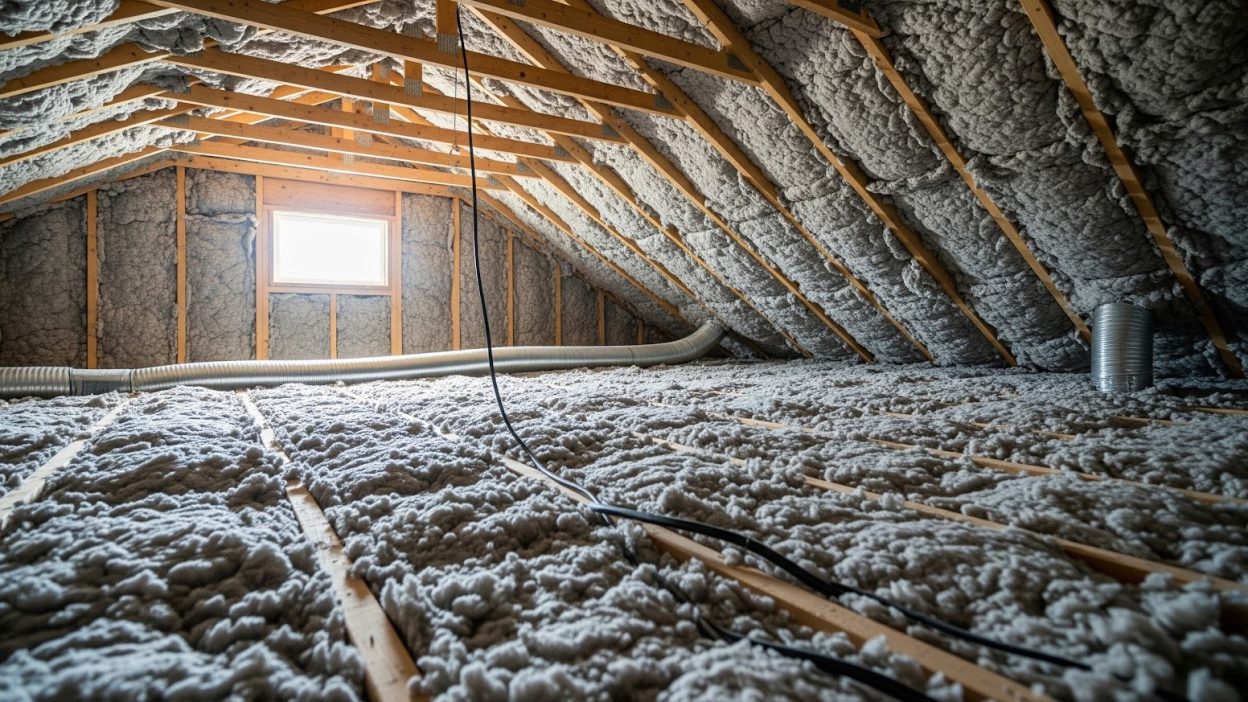
Step 2: Look at the type of insulation present. The two most common types in Ohio attics are fiberglass batts (the pink or yellow blanket-style material) and blown-in insulation (loose fill that looks like fluffy gray or white material).
Step 3: Measure the depth of the insulation in several spots across the attic floor, including near the perimeter where depth often decreases.
Step 4: Use the following general conversion guidelines to estimate your current R-value:
- Fiberglass batts: approximately R-3.1 to R-3.4 per inch
- Blown-in fiberglass: approximately R-2.2 to R-2.7 per inch
- Blown-in cellulose: approximately R-3.2 to R-3.8 per inch
- Spray foam (open-cell): approximately R-3.7 per inch
- Spray foam (closed-cell): approximately R-6.0 to R-6.5 per inch
For example, if you have 4 inches of blown-in fiberglass, your current R-value is roughly R-10, which is well below even the minimum Ohio code requirement. You would need to add a significant amount of insulation to reach R-49 or higher.
The ENERGY STAR Insulation Fact Sheet provides additional guidance on estimating existing R-values and calculating how much insulation you need to add.
Blown-In Insulation vs. Batt Insulation: Which Closes the Gap Fastest?
Once you know your current R-value, the next question is what type of insulation to add. For attic upgrades in Ohio, the two primary options are blown-in loose-fill insulation and fiberglass batt insulation.
Blown-In Insulation
Blown-in insulation, typically made from cellulose or fiberglass, is installed using a machine that blows loose material across the attic floor. It is the preferred method for topping up an existing attic because it fills around joists, rafters, and obstructions without cutting or fitting. Blown-in cellulose, in particular, is made largely from recycled newsprint and is an environmentally friendly option with good thermal performance.
For older Cincinnati homes where the attic has irregular framing or existing insulation that is not being removed, blown-in insulation is usually the faster and more cost-effective solution.
Batt Insulation
Fiberglass or mineral wool batts come in pre-cut panels sized to fit between standard framing members. They are a good option when an attic is being renovated, when air sealing work is being done at the same time, or when the attic framing is regular and easily accessible. Batts tend to be more appropriate for new construction or for situations where the attic floor is being fully rebuilt.
Federal Energy Tax Credits Through 2032
One of the most compelling reasons to upgrade your attic insulation now is the availability of federal tax credits under the Inflation Reduction Act. Through 2032, homeowners can claim a tax credit of 30 percent of the cost of qualifying insulation improvements, up to $1,200 per year. This credit applies to both blown-in and batt insulation materials, provided they meet ENERGY STAR requirements.
To qualify, the insulation must be installed in your primary residence and must bring the home into compliance with the 2021 IECC or above. The credit covers material costs but not labor. For more information on how to claim this credit, visit the IRS Energy Efficient Home Improvement Credit page.
Air Sealing: The Step Most Homeowners Skip
Before adding any insulation, a critical step that often gets overlooked is air sealing. Insulation slows conductive heat transfer, but if your attic has gaps around recessed lights, plumbing penetrations, attic hatches, or where walls meet the attic floor, warm air can bypass the insulation entirely through convection.
Sealing these gaps with caulk or spray foam before blowing in new insulation dramatically improves the effectiveness of the insulation itself. In many Ohio homes, air leakage accounts for a larger portion of heating costs than inadequate insulation levels alone. The ENERGY STAR Air Sealing Guide provides a practical checklist for identifying and addressing the most common air leakage points in residential attics.
Wrapping It Up: Why R-Value Is Worth Getting Right in Ohio
Understanding and upgrading attic insulation R-value in Ohio, Cincinnati is not a luxury home improvement project. It is one of the most cost-effective ways to reduce energy consumption, extend the life of your HVAC system, and make your home more comfortable in every season. Ohio’s cold winters and warm summers mean your attic insulation is working year-round, and getting it right pays dividends every month on your utility bill.
Ohio code sets R-38 as the floor, not the target. The Department of Energy’s recommendation of R-49 to R-60 for homes in this climate zone reflects where the real savings begin. For homeowners with older attics that currently sit at R-10 or R-15, even getting to R-38 represents a dramatic improvement. Getting to R-49 or beyond, while taking advantage of available federal tax credits, makes the math even more compelling.
Whether you are doing a quick depth check to understand where you stand or planning a full attic insulation upgrade, the information in this guide gives you a foundation for making an informed decision. You can also find local expertise by looking up insulation professionals serving the Cincinnati area to get an assessment and a quote from a qualified contractor.
Frequently Asked Questions
Q: What is the minimum R-value required for attic insulation in Ohio?
Ohio’s residential energy code requires a minimum of R-38 for attic insulation in new construction and major renovations. However, the U.S. Department of Energy recommends R-49 to R-60 for existing homes in Ohio’s climate zones to maximize energy savings.
Q: How do I know if my attic insulation is adequate?
You can check by measuring the depth of your current insulation with a ruler or tape measure and then multiplying by the approximate R-value per inch for your insulation type. If the total falls below R-38, your attic is below code minimums for new construction. If it falls below R-49, you are leaving significant energy savings on the table.
Q: Is blown-in insulation or batt insulation better for Ohio attics?
For most older Ohio homes where insulation is being added to an existing layer, blown-in insulation is the preferred method. It fills irregular spaces more effectively and is faster to install. Batt insulation is a better fit for new construction or attics being fully rebuilt.
Q: Can I claim a federal tax credit for adding attic insulation?
Yes. Under the Inflation Reduction Act, homeowners can claim a 30 percent tax credit on qualifying insulation material costs, up to $1,200 per year, through 2032. The insulation must meet ENERGY STAR requirements and be installed in your primary residence.
Q: Does attic insulation also help in the summer in Ohio?
Absolutely. In summer, attic insulation slows the transfer of heat from the hot roof assembly into your living space. This reduces the load on your air conditioning system and helps maintain more consistent indoor temperatures. Proper attic insulation is a year-round investment in Ohio’s variable climate.
Q: How much can I save by upgrading my attic insulation in Ohio?
The U.S. Department of Energy estimates that properly sealing and insulating your home, including the attic, can reduce heating and cooling costs by up to 30 percent. Actual savings will vary based on your home’s current insulation levels, size, and how you heat and cool the space, but most homeowners in Ohio see a meaningful reduction in monthly energy bills within the first heating season after an upgrade.